

Kitchen renovation across Sydney often reveal the same story: older layouts built for a different lifestyle, now struggling to meet modern expectations of simplicity, storage, and flow. This transformation is a clear example of how targeted design decisions can transform both function and visual clarity without unnecessary complexity.
The original kitchen reflected a common setup seen in suburbs like Parramatta and Ryde—bulky cabinetry, visible appliances, and fragmented surfaces. Overhead cupboards with small doors created visual noise, while the freestanding fridge and microwave niche interrupted the cabinetry line. Timber benchtops added warmth but also introduced maintenance concerns and inconsistent tones when paired with white panelled doors.
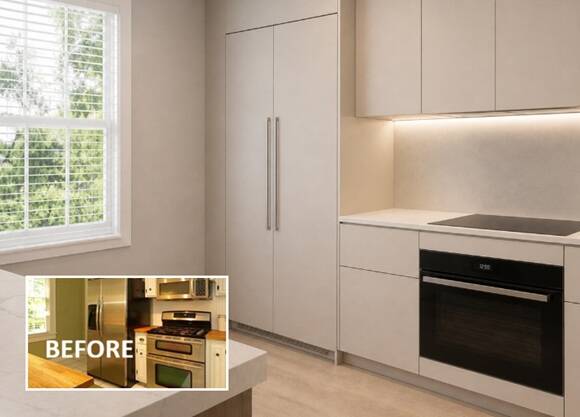
The renovation approach focused on integration and simplification. Full-height cabinetry was introduced to enclose the fridge, creating a continuous vertical plane and significantly improving spatial perception. This is a key design move increasingly adopted in areas like Chatswood and Hills District, where modern living favours clean, uninterrupted lines.
Cabinetry was redesigned using flat-panel doors with minimal handles, reducing visual clutter and aligning with contemporary design trends. The removal of overhead segmentation and decorative elements allowed the kitchen to feel more expansive despite similar dimensions. Storage efficiency improved through better internal configurations rather than adding more cupboards.
Material selection played a critical role. The original timber benchtop was replaced with a light-toned engineered stone surface, enhancing durability and reflecting more natural light. This change alone significantly brightened the space, particularly when combined with a neutral colour palette. Splashbacks were simplified into a continuous finish, eliminating grout lines and making cleaning easier—an increasingly important factor for homeowners.
Lighting was rethought to support both function and atmosphere. Under-cabinet LED strips were installed to provide direct task lighting, removing shadows from work areas and subtly highlighting the texture of the splashback. This type of layered lighting is now standard in higher-quality kitchen and bathroom renovations across Sydney.
Appliance integration was another defining upgrade. The oven and cooktop were aligned within a streamlined layout, while smaller appliances were concealed to maintain consistency. Removing the visual interruptions of standalone units allowed the design to read as a single cohesive volume.
These changes are not just aesthetic—they directly impact how the space is used daily. Improved workflow, better lighting, reduced maintenance, and smarter storage all contribute to a more functional kitchen environment. Similar principles are often applied in bathroom and full home renovation projects, where simplifying forms and improving material performance lead to long-term usability.
Across Sydney’s diverse housing styles—from Federation homes in Leichhardt to contemporary builds in Baulkham Hills—the shift toward integrated, minimal, and highly functional design continues to define successful renovation outcomes.
Add comment
Comments