

Sydney homeowners are increasingly rethinking how kitchens, bathrooms, and connected living spaces function within modern homes. Across areas such as the Upper North Shore, Inner West, Eastern Suburbs, and growing family suburbs including Chatswood, Ryde, Epping, Wahroonga, and Castle Hill, renovation trends are shifting away from decorative excess and moving toward practical layouts, integrated storage, cleaner lines, and materials that improve light, flow, and long-term usability.
The kitchen transformation shown in these before-and-after images is a strong example of how design adjustments can dramatically improve spatial perception without changing the room’s footprint. The original kitchen featured traditional timber cabinetry, darker splashback tiles, exposed appliance bulk, and segmented visual lines that made the compact space feel narrower and heavier. While functional, the older design reflected a layout style common in Sydney homes built or renovated during the late 1990s and early 2000s, where storage quantity often took priority over openness and circulation.
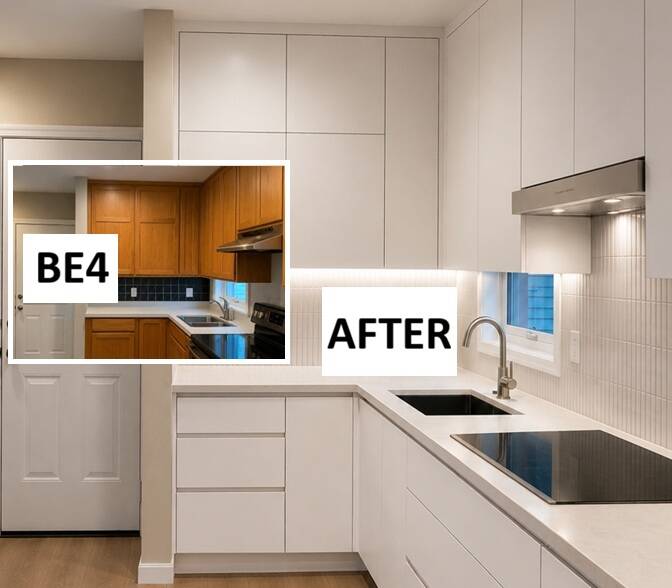
In the redesign, the space adopts a more contemporary architectural approach centred on simplicity, brightness, and efficiency. One of the most noticeable changes is the transition from timber cabinetry to matte white full-height cabinets. This immediately changes how natural and artificial light interact with the room. White surfaces reflect more ambient light, helping compact kitchens appear visually larger, particularly important in many Sydney terrace homes, duplexes, and apartments where kitchen areas are limited by existing floor plans.
The redesign also introduces cleaner vertical and horizontal lines throughout the joinery. Handleless drawer systems replace protruding cabinet hardware, reducing visual clutter while improving ergonomics. Larger drawer-based storage below the benchtop allows easier access to cookware and kitchen essentials compared to older hinged-door cabinetry. This layout style has become increasingly popular throughout Sydney kitchen renovations because it improves both workflow and accessibility without requiring additional floor space.
Another major improvement is the integration of the induction cooktop and streamlined rangehood system. Older kitchens commonly relied on bulky stainless-steel appliances that visually interrupted cabinetry continuity. In the updated layout, appliances are integrated more discreetly into the overall design language, creating a calmer and more cohesive appearance. Induction cooking has also become a preferred feature in many Sydney renovations due to faster heating performance, easier cleaning, and compatibility with energy-efficient homes and apartment regulations.
The splashback redesign plays an equally important role in the transformation. The original dark tiled splashback visually compressed the workspace by absorbing light and creating stronger contrast against surrounding finishes. In the updated kitchen, vertically stacked light-toned tiles create texture without overpowering the space. The subtle pattern introduces depth while maintaining a soft and balanced visual flow. This style of splashback detailing has become increasingly common in modern renovations across suburbs like Mosman, Neutral Bay, and Lane Cove, where homeowners often aim to achieve minimalist finishes without making interiors feel sterile.
Lighting strategy is another detail that significantly changes the functionality of the kitchen. Under-cabinet LED strip lighting improves task visibility while also creating a softer ambient effect during evening use. In many older Sydney homes, kitchens rely heavily on central ceiling lights that cast shadows across preparation areas. Layered lighting solutions, particularly under-cabinet illumination, improve both usability and atmosphere while emphasising material textures and clean joinery lines.
This design philosophy is also influencing bathroom renovation trends throughout Sydney. Similar principles seen in this kitchen transformation are now commonly applied to bathrooms through floating vanities, frameless shower screens, recessed storage niches, wall-hung fixtures, and large-format tiles that reduce grout lines and create cleaner visual continuity. In suburbs such as Northbridge, Hornsby, and Burwood, homeowners are prioritising bathrooms that feel brighter, easier to maintain, and more spacious despite limited room dimensions.
Home renovation projects across Sydney are also increasingly shaped by lifestyle changes following shifts toward hybrid work and more time spent at home. Kitchens are no longer viewed purely as cooking spaces; they often function as social zones, workspace extensions, and central gathering areas within open-plan homes. As a result, renovation planning now places greater emphasis on lighting flexibility, acoustic comfort, integrated appliances, and durable low-maintenance materials suitable for long-term daily use.
Contact us for more kitchen renovation and bathroom renovation services.
Add comment
Comments