

Home renovation projects are often most successful when they focus on improving how a space feels and functions rather than simply replacing old finishes with new ones. This Sydney bathroom renovation is a perfect example of how thoughtful planning, modern materials, and strategic design choices can completely transform an awkward and dated bathroom into a contemporary space that feels larger, brighter, and more practical for everyday living.
Many older homes throughout Sydney suburbs such as Mosman, Manly, Chatswood, Lane Cove, Neutral Bay, North Sydney, Willoughby and the Northern Beaches were built with bathrooms that reflected the design preferences of previous decades. While structurally sound, these bathrooms often suffer from visual clutter, poor lighting, outdated materials, and layouts that no longer suit modern lifestyles.
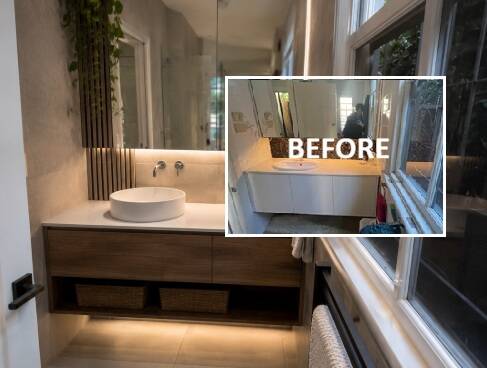
The before-and-after transformation shown in this project demonstrates how a relatively compact bathroom can be redesigned to maximise visual space while maintaining functionality and improving the overall appearance of the home.
The Challenges of the Original Bathroom
The original bathroom contained several design elements commonly found in older Sydney homes. While each component was functional on its own, together they created a space that felt visually heavy and disconnected.
The floor featured dark terracotta-style tiles laid diagonally throughout the room. Although popular in previous decades, the strong colour contrast and busy grout lines visually reduced the apparent floor area. The dark flooring absorbed natural light and made the narrow room feel smaller than it actually was.
The vanity was a large white cabinet suspended from the wall, combined with an inset basin and a dark mosaic tile splashback. The combination of multiple finishes competing for attention created visual fragmentation. Instead of acting as a focal point, the vanity area appeared cluttered and lacked cohesion.
A large mirror occupied much of the wall, but because it reflected numerous contrasting surfaces, colours and materials, it amplified the sense of visual noise rather than creating a feeling of openness.
Although the room benefited from a large window and abundant natural light, the surrounding finishes prevented the space from fully taking advantage of this asset. The overall result was a bathroom that felt dated, narrow and disconnected despite having good structural foundations.
A Modern Design Approach
The renovation adopted a design philosophy increasingly popular across bathroom renovations in Sydney: simplifying the material palette, reducing visual interruptions, and creating stronger connections between surfaces.
Rather than introducing more decorative elements, the new design relies on clean lines, natural textures, concealed lighting, and carefully selected finishes to create interest.
One of the most significant improvements is the introduction of large-format stone-look porcelain tiles. These tiles immediately establish a sense of calm and continuity throughout the room.
Because larger tiles require fewer grout joints, the eye can travel across the floor and walls without interruption. This creates the perception of a larger footprint and contributes significantly to the feeling of spaciousness.
Large-format tiling has become particularly popular in modern bathroom renovations throughout Sydney because it provides a timeless appearance while also being easier to maintain than smaller tiled surfaces.
The Impact of the Floating Timber Vanity
The new vanity completely changes the character of the room.
Instead of a bulky white cabinet with multiple visual breaks, the renovation introduces a floating timber vanity featuring clean horizontal lines and integrated storage.
The floating design exposes more floor area beneath the vanity, helping the room appear wider and less crowded. This is one of the most effective techniques used by bathroom designers when working with compact spaces.
The natural timber finish introduces warmth and texture while balancing the cooler tones of the stone-look tiles. The result is a more inviting environment that avoids feeling sterile or overly minimalist.
Open shelving below the vanity further contributes to the sense of openness. By reducing the visual mass of the joinery, the entire room feels lighter and more spacious.
This approach is commonly used in high-end bathroom renovations across Sydney's North Shore and Eastern Suburbs, where homeowners often seek a balance between luxury, functionality and timeless design.
Improving Visual Height Through Vertical Elements
A particularly successful feature of this renovation is the incorporation of vertical timber battens alongside the mirror.
Vertical design elements naturally draw the eye upward, creating an illusion of greater ceiling height. This subtle design technique is frequently used in modern home renovation projects to enhance spatial perception without altering the building structure.
The battens also provide texture and architectural interest without relying on excessive decoration.
Combined with the neutral colour palette, they create a sophisticated focal point that complements both contemporary and transitional interior styles.
Lighting as a Design Feature
Lighting plays a major role in the success of this renovation.
The original bathroom relied heavily on natural daylight and standard overhead lighting. While functional, this approach did little to enhance the room's architectural features.
The renovated bathroom incorporates integrated LED lighting behind the mirror and beneath the vanity.
This layered lighting strategy produces several benefits.
First, it creates a soft ambient glow that improves comfort and reduces harsh shadows. Second, it visually separates surfaces and adds depth to the room. Third, it contributes to the floating appearance of the vanity, reinforcing the perception of openness.
Backlit mirrors have become increasingly common in modern Sydney bathroom renovations because they combine practical task lighting with architectural impact.
The warm lighting also complements the timber joinery and natural stone tones, creating a more welcoming atmosphere during both daytime and evening use.
Maximising Natural Light
One of the strongest assets of this bathroom was always its large window.
Rather than competing with the natural light, the renovation embraces it.
The new neutral colour palette reflects daylight more effectively than the original dark finishes. Light-coloured tiles, soft wall tones and reflective surfaces work together to distribute natural light throughout the room.
This approach is particularly valuable in Sydney homes surrounded by mature gardens and established trees, where filtered sunlight can create beautiful natural illumination throughout the day.
The renovation demonstrates how preserving and enhancing natural light can often have a greater impact than increasing artificial lighting alone.
Creating Cohesion Through Material Selection
A key difference between the original and renovated bathroom is the level of material consistency.
The previous design contained numerous competing elements including terracotta flooring, white cabinetry, mosaic tiles, dark accents and multiple reflective surfaces.
The new design intentionally reduces the number of materials used.
Stone-look porcelain tiles, timber joinery, soft neutral walls and black hardware create a restrained palette that feels coordinated and timeless.
This approach reflects broader trends seen throughout contemporary kitchen renovation, bathroom renovation and home renovation projects in Sydney, where homeowners increasingly prioritise longevity over short-term design trends.
The result is a space that feels calmer, more refined and more adaptable to future styling changes.
Lessons for Sydney Homeowners
This renovation highlights several valuable principles that can be applied to many bathroom, kitchen and home renovation projects across Sydney.
Large-format tiles can make compact spaces feel significantly larger.
Floating joinery can improve both functionality and visual openness.
Integrated lighting can transform the mood and perception of a room.
Natural textures such as timber help balance modern materials.
A simplified material palette often creates a stronger design outcome than introducing additional decorative features.
Most importantly, successful renovations are not necessarily about increasing room size. They are about improving how space is experienced.
By carefully reconsidering layout, lighting, materials and visual flow, this bathroom renovation transformed a narrow and dated room into a modern, highly functional space that feels substantially larger, brighter and more inviting while remaining perfectly suited to contemporary Sydney living.
Contact us for more kitchen renovation and bathroom renovation services.
Add comment
Comments