

Kitchen renovations remain one of the most impactful home improvement projects across Sydney, particularly in established suburbs where many homes still feature layouts and finishes from previous decades. This project demonstrates how thoughtful design decisions, improved storage planning, and material selection can significantly enhance both functionality and visual appeal without altering the overall footprint of the home.
The original kitchen reflected a common style found throughout older Sydney properties in areas such as Newtown, Marrickville, Leichhardt, Ashfield, Annandale, and the Inner West. While the space was structurally sound, the kitchen featured bold blue cabinetry, exposed benchtop clutter, ageing finishes, and a layout that felt visually fragmented. Although natural light was available through the existing window and skylight, darker colours and inconsistent materials reduced the overall brightness of the room.
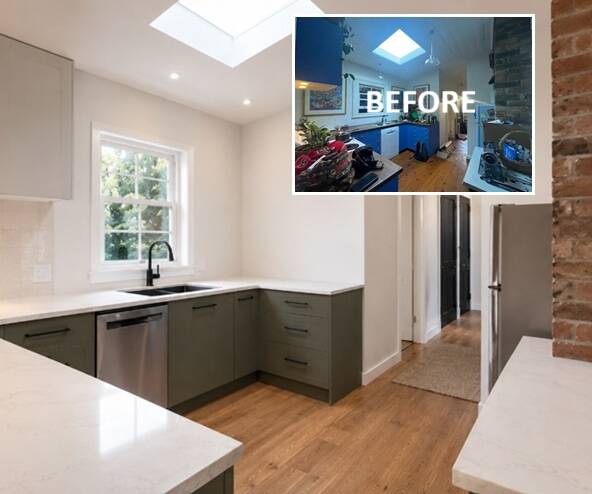
One of the most significant changes in this renovation was the simplification of the colour palette. The updated kitchen introduces soft neutral tones combined with muted olive-green base cabinetry and crisp white engineered stone benchtops. This creates a cleaner visual hierarchy throughout the room while allowing natural light to become a defining feature of the space. The result is a kitchen that feels larger, brighter, and more connected to the surrounding areas of the home.
The existing skylight was retained and incorporated into the new design. Skylights are increasingly popular in Sydney kitchen renovations, particularly in terrace homes, semi-detached properties, and narrow lot homes where access to side windows may be limited. By pairing the skylight with lighter wall colours and reflective stone surfaces, daylight is distributed more evenly throughout the kitchen, reducing reliance on artificial lighting during daytime hours.
Storage efficiency was another key focus of the renovation. The original kitchen contained cabinetry that did not fully maximise available wall and corner space. The redesigned layout introduces a more cohesive arrangement of drawers and cupboards, providing dedicated storage zones for cookware, utensils, pantry items, and cleaning supplies. Deep drawers improve accessibility and organisation while reducing the need to reach into lower cabinets.
From a workflow perspective, the renovation improves the relationship between the sink, dishwasher, preparation surfaces, and storage areas. Maintaining clear circulation paths is a critical aspect of modern kitchen design and contributes significantly to everyday usability. The revised layout allows multiple tasks to occur simultaneously while preserving open movement throughout the space.
Material selection also plays an important role in the transformation. Engineered stone benchtops provide a durable and low-maintenance surface suitable for busy family households. The matte cabinetry finish introduces texture without overwhelming the room, while contemporary black tapware and hardware create subtle contrast and visual definition. These finishes align with current renovation trends seen throughout Sydney's Inner West, North Shore, Eastern Suburbs, and Hills District, where homeowners increasingly favour timeless materials over highly decorative elements.
Flooring continuity contributes to the sense of openness achieved in the renovated space. The warm timber flooring complements the neutral palette while helping connect the kitchen to adjacent living areas and hallways. Consistent flooring is frequently used in modern home renovations to improve visual flow and create a stronger sense of cohesion between rooms.
Another notable improvement is the reduction of visual clutter. Contemporary kitchen design often prioritises clean lines, integrated storage, and simplified detailing. By minimising unnecessary decorative elements and focusing on practical storage solutions, the renovated kitchen achieves a more organised and functional environment. This approach is particularly valuable in Sydney homes where efficient use of space is often a priority.
The exposed brick element retained within the renovation provides an interesting architectural feature and introduces warmth and character to the otherwise contemporary palette. Retaining existing architectural details is a common strategy in Sydney renovation projects, especially within Federation, Victorian, and heritage-influenced homes where original features contribute to the property's identity.
Many of the design principles demonstrated in this project extend beyond kitchen renovations and can be applied to bathroom renovations and whole-home renovations. Improved natural lighting, efficient storage planning, cohesive material selection, and enhanced circulation are fundamental considerations across all residential renovation projects. Whether updating a bathroom in Ryde, renovating a kitchen in Balmain, or undertaking a complete home renovation in the Sutherland Shire, these principles help create spaces that are functional, durable, and adaptable to modern living.
This before-and-after transformation illustrates how a well-planned renovation can modernise an existing kitchen without requiring major structural changes. Through careful attention to layout, storage, lighting, materials, and circulation, the renovated space delivers improved functionality while creating a brighter and more welcoming environment suited to contemporary Sydney lifestyles.
Contact us for more bathroom renovation and kitchen renovation services in Chatswood.
Add comment
Comments